• The title here is, I believe, precisely why the Mormon church is steadily losing members, specifically from the Millennial and Gen-Z populations. Recent data from various sources shows a steep decline in church retention of members who have been raised in the church, which you can see here: Jana Riess: Data shows Gen Zers and millennials are leaving Mormonism. I suspect it’s because we live in an age of information. Anyone can do detailed research on any given subject, with access to a plethora of sources at our fingertips. It isn’t just contradictions with the Bible that are driving people away from Mormonism. It’s the illogical, implausible, and downright impossible claims that the Book of Mormon makes. We have thus far seen plenty of examples of the Book of Mormon’s divorce from reality. We will see more of this below.
    1 Nephi, Chapter 18

    The ship is finished. The births of Jacop and Joseph are mentioned. The company embarks for the promised land. The sons of Ishmael and their wives join in revelry and rebellion. Nephi is bound, and the ship is driven back by a terrible tempest. Nephi is freed, and by his prayer the storm ceases. The people arrive in the promised land. About 591-589 B.C.

    1: “And it came to pass that they did worship the Lord, and did go forth with me; and we did work timbers of curious workmanship. And the Lord did show me from time to time after what manner I should work the timbers of the ship.”

    2: “Now I, Nephi, did not work the timbers after the manner which was learned by men, neither did I build the ship after the manner of men; but I did build it after the manner which the Lord had shown unto me; wherefore; it was not after the manner of men.”

    This is yet one more example of the strange and needless repetition in the Book of Mormon. Verse two isn’t even necessary. I have no strong opinions on the claim that God showed him a special way of building the ship. I’m operating under the logical assumption that none of this is true anyway, so examining it isn’t going to change my conclusions. There are far bigger issues to address in this chapter.

    Verses 3-8 describe the ship being finished, the company gathering all their supplies, and setting sail. Verse 7 mentions Lehi had two more sons in the wilderness: Jacob (the older) and Joseph (the younger). Verses 9-11 involve Nephi’s brothers, the sons of Ishmael, and the wives getting rowdy and unruly. Nephi worries about the wrath of God and rebukes their behavior. This angers them (for the umpteenth time), so they tie Nephi up.

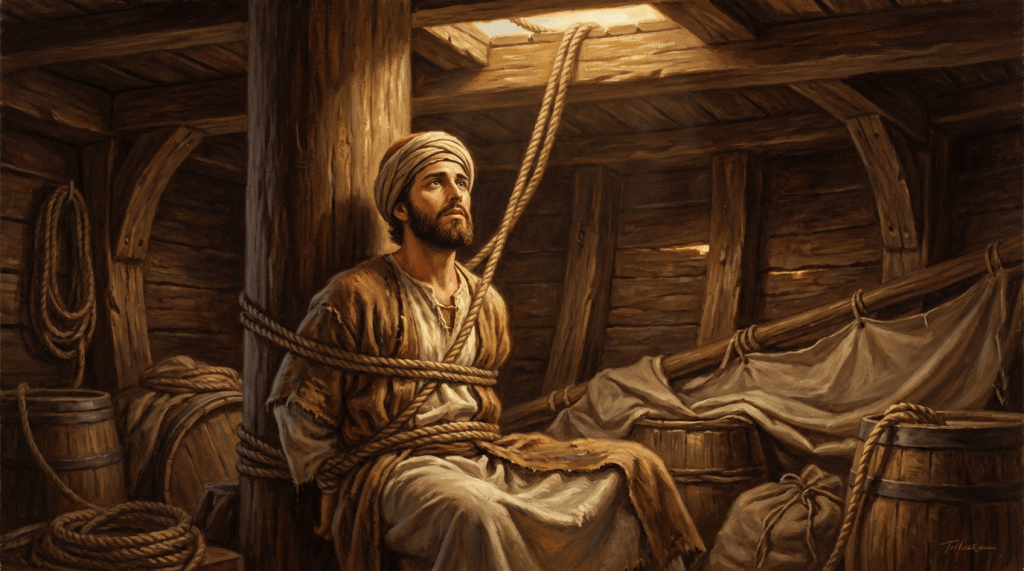
    12: “And it came to pass that after they had bound me insomuch that I could not move, the compass, which had been prepared of the Lord, did cease to work.”

    Here is our first major issue with this chapter: compasses didn’t exist back then. Even if God made a compass for Nephi, there wouldn’t have been a word for it. Interestingly enough, the first rudimentary compasses were actually used for divination and came into existence during the Han Dynasty, so around the 2nd century B.C. They used what’s called a lodestone, which is a naturally magnetized form of the mineral magnetite (see Invention of the Compass: History & Origins Explained). It wasn’t until much later that compasses were used for navigation. Somewhere between the 9th and 11th centuries, during the Song Dynasty, China underwent explosive growth in science, discovery, and knowledge. This is when Chinese scholars began to understand that the mechanisms behind the lodestone could be used for navigation. Some also speculate the Vikings’ sunstone coincide with their most prolific raids in the 10th and 11th centuries (Who Invented the Compass? A Brief History of the Compass and Its Evolution | History Cooperative). No matter where it originated, however, it’s blatantly obvious that people living in the time when this chapter in Nephi is purported to take place did not have access to this advanced technology.

    13: “Wherefore, they knew not whither they should steer the ship, insomuch that there was a great storm, yea, a great and terrible tempest, and we were driven back upon the waters for the space of three days; and they began to be frightened exceedingly lest they be drowned in the sea; nevertheless they did not loose me.

    Seems like there’s another story in the Old Testament about God causing a storm because he was mad at someone on a boat. Jonah, is that you? Granted, the reason for God’s wrath in that story was much different, and so was the outcome, but this is one more example of Joseph Smith appearing to take bits here and there from Old Testament stories and trying to pass them off as original to the Book of Mormon.

    14: “And on the fourth day, which we had been driven back, the tempest began to be exceedingly sore.”

    Smith seems to have developed a particular affinity for the word “exceedingly.”

    15: “And it came to pass that we were about to be swallowed up in the depths of the sea. And after we had been driven back upon the waters for the space of four days, my brethren began to see that the judgments of God were upon them, and that they must perish save that they should repent of their iniquities; wherefore, they came unto me, and loosed the bands which were upon my wrists, and behold they had swollen exceedingly; and also mine ankles were much swollen, and great was the soreness thereof.”

    So the tempest, his ankles, and his wrists were all exceedingly sore. Verses 16-20 essentially consist of Nephi using way too many words to describe how old, decrepit, and stressed his parents were because of everyone else’s behavior. He also points out, again in too many words, that Lehi’s two youngest sons, Nephi’s wife, and his kids were also all pretty worked up over Nephi being tied up while a storm raged for four days. He goes on to report that the only thing that softened the hearts of the rest of the hellions on board was the threat of drowning in the storm.

    21: “And it came to pass after they had loosed me, behold, I took the compass, and it did work whither I desired it. And it came to pass that I prayed unto the Lord; and after I had prayed the winds did cease, and the storm did cease, and there was a great calm.”

    22: “And it came to pass that I, Nephi, did guide the ship, that we sailed again towards the promised land.”

    23: “And it came to pass that after we had sailed for the space of many days we did arrive at the promised land; and we went forth upon the land, and did pitch our tents; and we did call it the promised land.”

    24: “And it came to pass that we did begin to till the earth, and we began to plant seeds; yea, we did put all our seeds into the earth, which we had brought from the land of Jerusalem. And it came to pass that they did grow exceedingly (yes, exceedingly!); wherefore, we were blessed in abundance.

    25: “And it came to pass that we did find upon the land of promise, as we journeyed in the wilderness, that there were beasts in the forests of every kind, both the cow and the ox, and the ass and the horse, and the goat and the wild goat, and all manner of wild animals, which were of use of men. And we did find all manner of ore, both of gold, and of silver, and of copper.”

    I tried to find out where the Mormon church believes Nephi landed, but it seems there’s no consensus on the location. Some suggest it was South America. Others think it was central America. Still others believe it was North America. Since no one has any idea whatsoever where this may have happened, I’ll show my research on the claims laid forth in verse 25 in respect to all three locations.

    It is well-documented that horses disappeared from the fossil records of the Americas around 10,000 years ago. Horses were not reintroduced into the Americas until the time of the conquistadors. The arrival of domesticated horses came with Cortes in 1519. By 1525, there were enough domesticated horses in Mexico for horse-breeding to thrive and spread to other regions (Equine History – Return to Freedom). More recent research has demonstrated that North American Indigenous tribes came to own horses through northward trading networks. This refutes the common idea that horses spread in North America due to The Pueblo Revolt of 1680, which took place in New Mexico (New Research Rewrites the History of American Horses). Therefore, there is absolutely no way that people coming to the Americas between 591-589 B.C would have seen horses of any kind, no matter where they landed. Donkeys share a similar history and were also brought to the Americas in the 1500’s by Spanish settlers (Celebrating 250: Heritage Donkeys in American History – The Livestock Conservancy).

    Christopher Columbus brought cows to the Island of Hispaniola (now Haiti and the Dominican Republic) in 1493. From there, Spanish settlers brought them to the mainland of Mexico and Central America where they established large herds. From there, cattle spread south and north (When Cows Came to America – The Archaeological Conservancy). Oxen were brought to North America much later by English colonists, with Edward Winslow bringing Devon cattle to Plymouth Colony. Shorthorns were brought over in 1783. Oxen became very popular working animals and played a key role in the settling of America (Working Cattle in Early America | Ox Hill Devons, #variables.PageTitle# | The Colonial Williamsburg Official History & Citizenship Site). You can read about how goats also definitely weren’t in the Americas during this time period here: History of the U.S. Goat Industry.

    I’m not even going to delve into the mining operations described here because the presence of these metals in various regions in the Americas proves nothing in light of the aforementioned issues with the animals. Stay tuned for more, ladies and gents. We’re not even all the way through the first book in the Book of Mormon.
  • When my older brother was trying to learn multiplication, my mother would dutifully hold up flash cards at the kitchen table, expecting him to answer as quickly as possible. Only he wouldn’t. In fact, he made sure to pour himself a big glass of milk beforehand so he could conveniently “take a drink of milk” if our mom held up a particularly difficult card. We all knew perfectly well what he was doing (well, probably not me because I was still quite young), which led to teasing him about it when he got older. He was procrastinating. He was using his apparent thirst for milk as a way of postponing his answer to those pesky multiplications. He took a swig of milk to give him time to think. I feel like that’s what I’ve been doing with this post. For the past week, I have told myself that I will get this done only to open my laptop and go to YouTube instead. I have a headache. I’m tired. I should make tea first. I should shower, then I’ll definitely get it done. So here I sit with my still wet hair from my shower, a cup of tea, no headache or fatigue, and no more excuses. Let’s dive into 1 Nephi chapter 17… all 55 verses of it.

    1 Nephi chapter 17

    Nephi is commanded to build a ship. His brethren oppose him. He exhorts them by recounting the history of God’s dealings with Isreal. Nephi is filled with the power of God. His brethren are forbidden to touch him, lest they whither as a dried reed. About 592-591 B.C.

    1: “And it came to pass that we did again take our journey in the wilderness; and we did travel nearly eastward from that time forth. And we did travel and wade through much affliction in the wilderness; and our women did bear children in the wilderness.”

    2: “And so great were the blessings of the Lord upon us, that while we did live upon raw meat in the wilderness, our women did give plenty of suck for their children, and were strong, yea, even like unto men; and they began to bear their journeyings without murmurings.”

    Laying aside the obvious food-borne illnesses relating to regularly eating raw meat, this would have violated Old Testament laws regarding meat consumption. Genesis 9:4 states, “But you must not eat meat that still has its lifeblood in it.” Leviticus 7:26-27 in the NASB reads, “And you are not to eat any blood, either of bird or animal, in any of your dwellings. Any person who eats any blood, even that person shall be cut off from his people.” Leviticus 17:10-11 reinforces this: “And any man from the house of Isreal, or from the aliens who sojourn among them, who eats any blood, I will set my face against that person who eats blood, and will cut him off from among his people. For the life of the flesh is in the blood, and I have given it to you on the altar to make atonement for your souls; for it is the blood by reason of the life that makes atonement.” While these verses and others like them don’t explicitly say “raw meat,” raw meat in the Old Testament would have had blood in it. Ezekiel 24 contains a parable of a boiling pot that meat is cooked in to illustrate purification. The description in that parable reflects the cultural norm of cooking meat. Even if not explicitly condemned, eating raw meat certainly would have been out of the ordinary, as the Old Testament contains no passages describing someone eating it and many passages talking about how to cook it.

    3: “And thus we see that the commandments of God must be fulfilled. And if it so be that the children of men keep the commandments of God he doth nourish them, and strengthen them, and provide means whereby they can accomplish the thing which he has commanded them; wherefore, he did provide means for us while we did sojourn in the wilderness.”

    4: “And we did sojourn for the space of many years, yea, even eight years in the wilderness.”

    So the children who were “strong, yea, like even like unto men” couldn’t have been more than about 7 years old.

    5: “And we did come to the land which we called Bountiful, because of its much fruit and also wild honey; and all these things were prepared of the Lord that we might not perish. And we beheld the sea, which we called Irreantum, which, being interpreted, is many waters.”

    There are a couple of strange things about this verse. The first one is the name “Bountiful.” In the Bible, and even here in the Book of Mormon, names for places are transliterated, not directly translated. Yet Smith has done both of those things in the same verse. In other words, whatever the Hebrew (or, in the case of the Book of Mormon, Egyptian) word for “Bountiful” was, that is what we would be reading because it would be transliterated from that word into similar sounding syllables in English. We wouldn’t be reading the word Bountiful.

    I’d also like to point out the oddity of the word “Irreantum,” which doesn’t appear in any other ancient extant text anywhere. The sources I looked up to understand this word were all pro-LDS sites, save for one letter to an academic journal in 1985 refuting the Mormon claims about that word. The LDS scholars believe it has roots in some ancient South Semitic language they believe would have been spoken by local tribes to the area that Lehi and his family traveled to. You can read that study here for more information: What’s in a Name? Irreantum. That article was easily the most cited one in all the LDS sources I read. In fact, I couldn’t find any other academic papers besides that one on the subject. While it’s certainly possible more exist and I simply didn’t find them, it’s strange that one prominent paper was what all sources cited. Shouldn’t there be other scholars chiming in? Speaking of which, you can read the dissenting opinion here: Science in Christian Perspective.

    The only conclusion I can draw regarding the lack of sources countering the claims about the origins of Irreantum is that non-LDS scholars don’t take the Book of Mormon seriously enough to delve into a study of its linguistics. This phenomenon can be observed in other topics such as archeology, biology, and theology. If the ONLY academics studying these topics through the lens of the Book of Mormon are LDS scholars and no one else from any other institution, that should probably tell us something.

    6: “And it came to pass that we did pitch our tents by the seashore; and notwithstanding we had suffered many afflictions and much difficulty, yea, even so much that we cannot write them all, we were exceedingly rejoiced when we came to the seashore; and we called the place Bountiful, because of its much fruit.”

    7: “And it came to pass that I, Nephi, (Yes, yes. We already know it’s you, Nephi) had been in the land of Bountiful for the space of many days, the voice of the Lord came unto me, saying: Arise, and get thee into the mountain. And it came to pass that I arose and went up into the mountain, and cried unto the Lord.”

    8: “And it came to pass that the Lord spake unto me, saying: Thou shalt construct a ship, after the manner which I shall show thee, that I may carry thy people across these waters.”

    A common complaint I hear with remakes of movies nowadays is that no one is coming up with original material. They take beloved characters and change them. They add in their own nonsensical plots and take away vital plot points in the source material. I now see that practice is definitely nothing new. Here we see Smith taking yet another Bible story, changing it, and trying to pass it off as true. If this Nephi person really wanted to build a big boat, all he had to do was consult the Pentateuch. I’m sure there’s an “I Noah guy” joke in there somewhere.

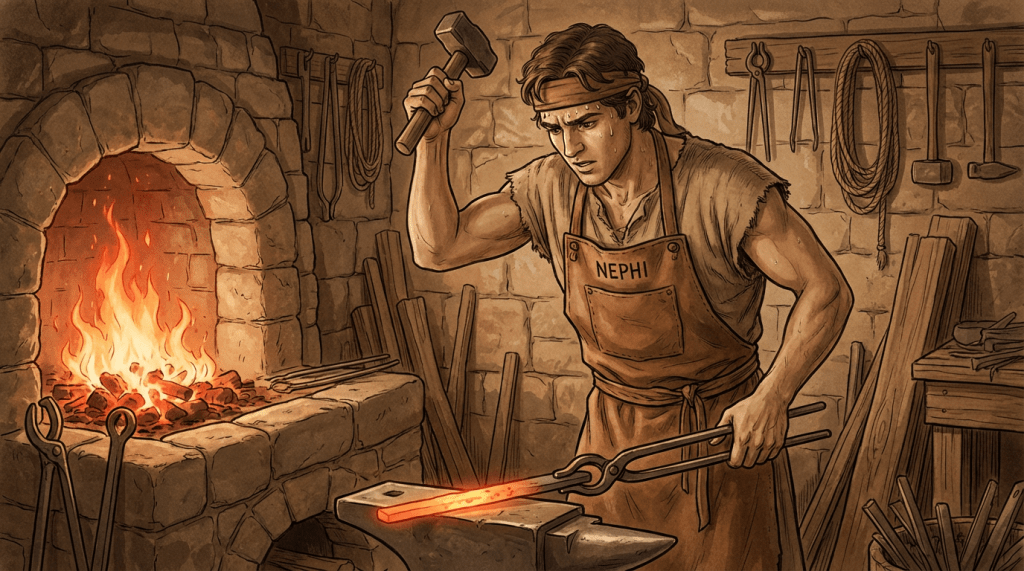
    9: “And I said: Lord, whither shall I go that I may find ore to molten, that I may make tools to construct the ship after the manner which thou has shown unto me?”

    10: “And it came to pass that the Lord told me whither I should go to find ore, that I might make tools.”

    So they had a small mining operation in Bountiful, too.

    11: “And it came to pass that I, Nephi, did make a bellows wherewith to blow the fire, of the skins of beasts; and after I had made a bellows, that I might have wherewith to blow the fire, I did smite two stones together that I might make fire.”

    12: “For the Lord had not hitherto suffered that we should make much fire, as we journeyed in the wilderness; for he said: I will make thy food become sweet, that ye cook it not;”

    This just read like Joseph Smith added it in as an afterthought when he realized how implausible eating raw meat consistently was. This still doesn’t solve the problem of Old Testament food laws, though.

    13: “And I will also be your light in the wilderness; and I will prepare the way before you, if it so be that ye shall keep my commandments; wherefore, inasmuch as ye shall keep my commandments ye shall be led towards the promised land; and ye shall know that it is by me that ye are led.”

    14: “Yea, and the Lord said also that: After ye have arrived in the promised land, ye shall know that I, the Lord, am God; and that I, the Lord, did deliver you from destruction; yea, that I did bring you out of the land of Jerusalem.”

    I cannot find a single instance in the Old Testament of the phrase “land of Jerusalem.” Ancient Hebrews didn’t use that phrase to describe Isreal as a whole, saying instead, “land of Israel.” If they were referring to Jerusalem, they simply said that and left out the prefix “land of.” There is no reason for Nephi, then, to consistently use this phrase.

    Verses 15-22 can be summarized thus: Nephi makes the tools to build the ship. His brothers want nothing to do with any of it and openly mock him for it. In verse 20, they say he is foolish just like their father, who led them out of Jerusalem. They proceed to insist they would have been better off had they stayed there and not wandered in the wilderness for 8 years and even go far enough to call the people of Jerusalem righteous.

    In verses 23-25, Nephi reminds them of God bringing the Israelites out of Egypt through Moses.

    26: “Now ye know that Moses was commanded of the Lord to do that great work; and ye know that by his word the waters of the Red Sea were divided hither and thither, and they passed through on dry ground.”

    27: “But ye know that the Egyptians were drowned by the Red Sea, who were the armies of Pharoah.”

    This is documented in Exodus 14:13-31. It matches the Biblical account to try to seem legitimate.

    28: “And ye also know that they were fed with manna in the wilderness.”

    This correlates with Exodus 16.

    29: “Yea, and ye also know that Moses, by his word according to the power of God which was in him, smote the rock, and there came forth water, that the children of Israel might quench their thirst.”

    This took place in Exodus 17.

    30: “And notwithstanding they being led, the Lord their God, their Redeemer, going before them, leading them by day and giving light to them by night, and doing all things for them which were expedient for man to receive, they hardened their hearts and blinded their minds, and reviled against Moses and against the true and living God.”

    31: “And it came to pass that according to his word he did destroy them; and according to his word he did lead them; and according to his word he did do all things for them; and there was not any thing done save it were by his word.”

    Exodus 13:21 describes the way God led the Israelites: a pillar of cloud by day and a pillar of fire by night. It’s also very well-documented that Israel was incredibly fickle in their devotion to God and regularly complained to Moses and Aaron.

    Verses 32-38 involve Nephi describing the Israelites defeating the unrighteous pagan nations that inhabited the land before them.

    39: “He ruleth high in the heavens, for it is his throne, and this earth is his footstool.”

    This is taken from Isaiah 66:1, which says, “Thus says the Lord, ‘Heaven is My throne, and the earth is My footstool.”

    40: “And he loveth those who will have him to be their God. Behold, he loved our fathers, and he covenanted with them, yea, even Abraham, Isaac, and Jacob; and he remembered the covenants which he had made; wherefore, he did bring them out of the land of Egypt.”

    41: “And he did straiten them in the wilderness with his rod; for they hardened their hearts, even as ye have; and the Lord straitened them because of their iniquity. He sent fiery flying serpents among them; and after they were bitten he prepared a way that they might be healed; and the labor which they had to perform was to look; and because of the simpleness of the way, or the easiness of it, there were many who perished.”

    Verse 41 is referencing Numbers 21:6-9. The serpents are described as fiery, but certainly not flying, so I’m not sure why Smith decided it was necessary to add something so obviously false. The passage in Numbers also reports that many people died from being bitten, not because of “the easiness” of looking at the bronze serpent. That’s an incredibly strange and nonsensical claim to make. The simplicity would have saved many lives, not hampered their healing.

    Verses 42-47 consist of Nephi continuing to rebuke his brothers, describing the hardening of the Israelites’ hearts and coming captivity. He calls his brothers murderers for wanting to kill their father and him. He talks about how powerful God is and wonders why they continue to be stubborn and not obey God. He tells them how anguished he is because of their stubbornness then announces he is “full of the Spirit of God, insomuch that my frame has no strength.”

    In verse 48, his brothers want to kill him (for the umpteenth time), but Nephi calls on the power of God and tells them that if they touch him, they’ll wither up and die. He tells them in verse 49 to quit complaining and help him build his ship. Verses 50-51 consist of Nephi describing how powerful God is and that power will enable him to complete the task of building a ship. He makes sure to inform us in 52 that his brothers kept their hands to themselves. They didn’t want to wither away, after all.

    53: “And it came to pass that the Lord said unto me: Stretch forth thine hand again unto thy brethren, and they shall not wither before thee, but I will shock them, saith the Lord, and this will I do, that they may know that I am the Lord their God.”

    Shock them? In what sense? Are we talking some nasty shock from static electricity or something else?

    54: “And it came to pass that I stretched forth my hand unto my brethren, and they did not wither before me; but the Lord did shake them, even according to the word which he had spoken.”

    So, God scared them in some way. That’s not near as fun as the idea of Nephi reaching out and shocking them out of their sandals with some holy static electricity from heaven. Oh, well.

    55: “And now, they said: We know of a surety that the Lord is with thee, for we know that it is the power of the Lord that has shaken us. And they fell down before me, and were about to worship me, but I would not suffer them, saying: I am they brother, yea, even they younger brother; wherefore, worship our Lord thy God, and honor they father and thy mother, that thy days may be long in the land with the Lord thy God shall give thee.

    This seems like it was taken from Acts 14, where people started calling Paul and Barnabas Hermes and Zeus, respectively, and were going to offer sacrifices to them. Paul stopped them, of course, and told them to worship God instead.

    And that’s a wrap. Finally. But being the little contrarian I am, I’ll be back in not too long with more commentary on the rest of the Book of Mormon. But for now, it’s time to sign off for the night. Stay tuned, ladies and gents.

  • I procrastinated today. I promised myself I’d get this post done earlier this afternoon. I swore I would manage my time wisely today so I could relax and either do some reading or get cozy on the couch and watch some Mr. Ballen on YouTube. But life happened differently today. I went to church, wandered on over to the range with some friends, happily destroyed several targets, then we all decided we needed to buy more ammo. Then, we decided we were all hungry so we stuffed our faces at Perkins and took up space in the booth for probably 2 hours (don’t worry, the waitress was tipped well). My friend and her husband are the sorts of people who are very easy to talk to for hours on end. She’s a history nerd. History is to her as theology is to me. Over coffee and iced tea, we excitedly discussed history and religion. Our discussion meandered over to the Book of Mormon with its historical inaccuracies. Indeed, Smith had an affinity for distorting facts, plagiarizing ideas, and outright making things up. We will continue to see this in today’s reading.

    1 Nephi Chapter 16

    The wicked take the truth to be hard. Lehi’s sons marry the daughters of Ishmael. The Liahona guides their course in the wilderness. Messages from the Lord are written on the Liahona from time to time. Ishmael dies; his family murmurs because of afflictions. About 600-592 B.C.

    Verses 1-6 report that Nephi’s brothers are distressed at the things he has prophesied. Nephi tells them if they heed the commands of God, then truth and prophecies won’t be difficult for them to hear. His brothers humble themselves and agree to walk in righteousness. The entourage that accompanied them is mentioned again in verse 7 when Lehi’s sons and the servant Zoram marry Ishmael’s daughters.

    8: “And thus my father had fulfilled all the commandments of the Lord which had been given unto him. And also, I, Nephi, had been blessed of the Lord exceedingly.”

    9: “And it came to pass that the voice of the Lord spake unto my father by night, and commanded him that on the morrow he should take his journey into the wilderness.”

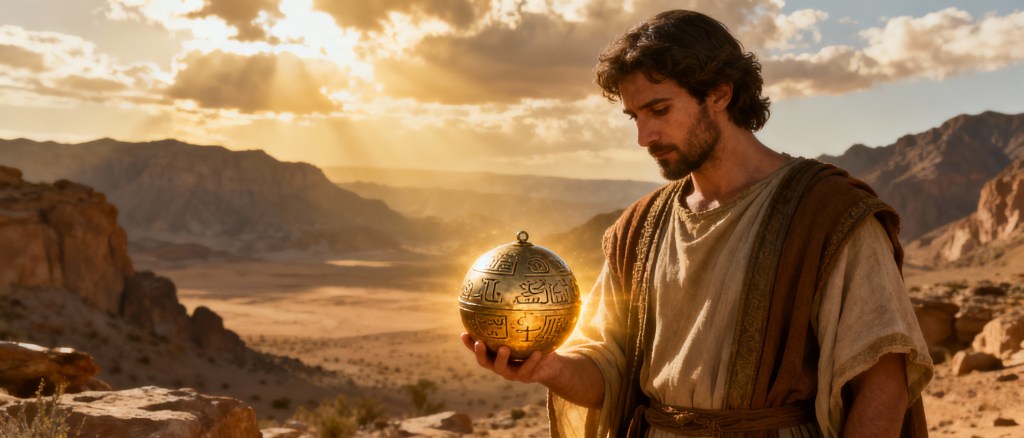
    10: “And it came to pass that as my father arose in the morning, and went forth the tent door, to his great astonishment he beheld upon the ground a round ball of curious workmanship; and it was of fine brass. And within the ball were two spindles; and the one pointed the way wither we should go into the wilderness.”

    First of all, what shape is a ball other than round? Why is it necessary to declare this brass ball as round? This redundancy is something I would expect from children who are learning how to navigate and describe the world around them. The second, and more important issue is the material this supposed ball was made of: brass. As I have mentioned in a much earlier post, the alloy that makes up brass was not known to the ancient Hebrews. The word used there is more accurately translated to “bronze.” Earlier English translations only used the word “brass” because “bronze” did not exist in the English language until the 18th century. See Ancient Brass or Bronze – Bible History Online – Bible History for more information. So, we basically have a compass that appeared out of nowhere made from a material that didn’t exist back then.

    Verses 11-17 repetitively describe how they packed up all their belongings, plus seeds for crops, and traveled in the wilderness, following the directions given by the brass ball. They hunt for food with “our bows and our arrows and our stones and our slings.”

    18: “And it came to pass that as I, Nephi, went forth to slay food, behold, I did break my bow, which was made of fine steel; and after I did break my bow, behold, my brethren were angry with me because of the loss of my bow, for we did obtain no food.”

    I’m shocked there are so many issues contained in just one verse. What happened to all the other implements of hunting for food? More bows, arrows, slings, and stones were mentioned in verse 15. We also have another issue with an inappropriate material: a bow made of steel. While steel existed during this time, it was absolutely not used in making bows. Ancient bows were typically made of flexible wood and were often mounted with bronze. Other ancients made bows out of horn. The strings were most commonly ox-gut, and the arrows were either reed or a light wood tipped with either bronze, iron, or flint. Steel was not used in any part of any ancient bow or arrow (see Archery in the Bible Encyclopedia – ISBE (Bible History Online). In fact, bows made of metal were not made until the 15th century. There are ornate, decorative metal reflex bows that were manufactured during the Indo-Persian Mughal empire, but those were ceremonial and not used for battle. European crossbow makers began to include steel in their designs, but a longbow made of steel was out of the question because it would be too strong for anyone to pull back by hand. You can read about the history of bow-making here: The history of metal bows – Bow International.

    In addition to that glaring issue, I have another question: how in the world would he manage to break a bow made of steel? What on earth would he have had to do to exert enough force to break steel? Anyone capable of rational thinking should take issue with this.

    19: “And it came to pass that we did return without food to our families, and being much fatigued, because of their journeying, they did suffer much for the want of food.”

    20: “And it came to pass that Laman and Lemuel and the sons of Ishmael did begin to murmur exceedingly, because of their sufferings and afflictions in the wilderness; and also my father began to murmur against the Lord his God; yea, and they were exceedingly sorrowful, even that they did murmur against the Lord.”

    I’m beginning to murmur against myself for deciding to undertake this project.

    21: “Now it came to pass that I, Nephi, having been afflicted with my brethren because of the loss of my bow, and their bows having lost their springs, it began to be exceedingly difficult, yea, insomuch that we could obtain no food.”

    So everyone else’s bow was also out of service? What happened to the slings and stones? And why were they mad at Nephi over his bow breaking but not everyone else’s being out of commission?

    22: “And it came to pass that I, Nephi, did speak much unto my brethren, because they had hardened their hearts again, even unto complaining against the Lord their God.”

    23: “And it came to pass that I, Nephi, did make out of wood a bow, and out of a straight stick, an arrow; wherefore, I did arm myself with a bow and an arrow, with a sling and with stones. And I said to my father: Whither shall I go to obtain food?”

    Making a bow out of wood is the only non-problematic element in this chapter.

    24: “And it came to pass that he did inquire of the Lord, for they had humbled themselves because of my words; for I did say many things unto them in the energy of my soul.”

    25: “And it came to pass that the voice of the Lord came unto my father; and he was truly chastened because of his murmuring against the Lord, insomuch that he was brought down into the depths of sorrow.”

    26: “And it came to pass that the voice of the Lord said unto him: Look upon the ball, and behold the things which are written.”

    27: “And it came to pass that when my father beheld the things which were written upon the ball, he did fear and tremble exceedingly, and also my brethren and the sons of Ishmael and our wives.”

    What was so terrifying that everyone was trembling? What did it say?

    28: “And it came to pass that I, Nephi, beheld the pointers which were in the ball, that they did work according to the faith and diligence and heed which we did give unto them.”

    So, you’re not going to tell us what it said. But also, how can you put “faith and diligence and heed” unto inanimate objects? I think there’s a word for that.

    29: “And there was also written upon them a new writing, which was plain to be read, which did give us understanding concerning the ways of the Lord; and it was written and changed from time to time, according to the faith and diligence which we gave unto it. And thus we see that by small means the Lord can bring about great things.”

    Putting faith and diligence unto inanimate objects is what pagans did. It’s called idolatry. We have faith in God, not objects. I’m reminded of the ephod Gideon made that people started worshipping. That happens in Judges 8:24-28. It’s possible that Gideon didn’t make it intending for people to worship it, but that’s what happened. An interesting commentary on this can be found here: Why did Gideon make an ephod from the gold in Judges 8:27?. While Joseph Smith certainly wanted this sphere to be viewed positively by his followers, he goofed with this seemingly small detail. We are to trust in God and God only. See Psalm 115.

    Verses 30-33 describe Nephi successfully hunting for food and bringing it back to camp, much to the joy of everyone else. They continue traveling.

    34: “And it came to pass that Ishmael died, and was buried in the place which was called Nahom.”

    35: “And it came to pass that the daughters of Ishmael did mourn exceedingly, because of the loss of their father, and because of their afflictions in the wilderness; and they did murmur against my father, because he had brought them out of the land of Jerusalem, saying: Our father is dead; yea, and we have wandered much in the wilderness, and we have suffered much affliction, hunger, thirst, and fatigue; and after all these sufferings we must perish in the wilderness with hunger.”

    36: “And thus they did murmur against my father, and also against me; and they were desirous to return again to Jerusalem.”

    I have pointed out in previous posts that stories in the Book of Mormon are reminiscent of ones in the Old Testament of the Bible. The Pentateuch is full of the Israelites complaining bitterly against Moses and Aaron, insisting they brought them to the wilderness to starve them all and kill them. They even demand, at some point, to be taken back to Egypt. I think it’s a safe bet to believe Smith drew his inspiration for 1 Nephi from those events in the Bible. He appears to be trying to set up Nephi as some sort of Moses figure. The brass ball, leading them to where they’re supposed to go, is similar to God traveling as a pillar of cloud by day and of fire by night. The Israelites followed the pillar wherever it went and stopped when it stopped. See Exodus 13:21. Another recognizable pattern is Nephi’s brothers getting angry, conspiring against him, then repenting. This, too, follows the pattern of the Israelite’s behavior, which we will see in the next few verses.

    37: “And Laman said unto Lemuel and also the sons of Ishmael: Behold, let us slay our father, and also our brother Nephi, who has taken it upon him to be our ruler and our teacher, who are his eldest brethren.”

    38: “Now, he says that the Lord has talked with him, and also that angels have ministered unto him. But behold, we know that he lies unto us; and he tells us these things, and he worketh many things by his cunning arts, that he may deceive our eyes, thinking, perhaps, that he may lead us away into some strange wilderness; and after he has led us away, he has thought to make himself a king and a ruler over us, that he may do with us according to his will and pleasure. And after this manner did my brother Laman stir up their hearts to anger.”

    39: “And it came to pass that the Lord was with us, yea, even the voice of the Lord came and did speak many words unto them, and did chasten them exceedingly; and after they were chastened by the voice of the Lord they did turn away their anger, and did repent of their sins, insomuch that they Lord did bless us again with food, that we did not perish.”

    See what I mean? Tune in this week for more. The next chapter is going to require copious amounts of coffee, pacing around the room periodically, and occasional snuggles from my cat. It has 55 verses. God help me.

  • I had every intention of being productive today. I had lofty goals. I was going to cook up a storm in my kitchen for my monthly meal prep. But a different storm (a geomagnetic one, to be exact) disrupted the one I was planning and the power was in and out during the afternoon. With my plans for the day out the window, my mind wandered to other things. I considered going to the range. I almost talked myself into going for a run. Finally, my mind settled on my purpose for this blog, and I decided to stop procrastinating on my next entry and just sit down and do it. While I’ll be pointing out my observations throughout this chapter, my main focus will be on Smith’s deeply flawed theology concerning hell and Satan.

    1 Nephi Chapter 15

    Lehi’s seed are to receive the gospel from the Gentiles in the latter days. The gathering of Israel is likened unto an olive tree whose natural branches will be grafted in again. Nephi interprets the vision of the tree of life and speaks of the justice of God in dividing the wicked from the righteous. About 600-592 B.C.

    1: “And it came to pass that I, Nephi, had been carried away in the Spirit, and seen all these things, I returned to the tent of my father.”

    The phrase “I, Nephi” is repetitive and completely unnecessary. It has occurred repeatedly throughout this book so far, and quite frankly, it’s getting on my nerves. It is yet one more oddity that differs from the Bible. You will not see this type of phrase in any of its books. When a book of the Bible is written in the first person, simply “I” is used because it is logically presumed that “I” means the person after whom the book is named (Jeremiah, Isaiah, Nehemiah, etc.) I’ve only just now gotten around to addressing it because there have been so many other pressing issues that it seemed minor in comparison.

    The next few verses report that Nephi’s brothers are arguing amongst themselves about their father’s visions. Nephi describes feeling distressed by this and points out that their hearts are hardened towards God and that’s why they lack understanding. I also can’t help but notice the total absence of any mention of any of the other people who were supposed to have joined them in this area. It’s like someone excitedly announcing a new relationship on Facebook then soon after removing all traces of the other person as if they didn’t exist. Anyway, on to other things.

    12: “Behold, I say unto you, that the house of Israel was compared unto an olive tree, by the Spirit of the Lord which was in our father; and behold are we not broken off from the house of Israel, and are we not a branch of the house of Israel?”

    13: “And now, the thing which our father meaneth concerning the grafting in of the natural branches through the fulness of the Gentiles, is, that in the latter days, when our seed shall have dwindled in unbelief, yea, for the space of many years, and many generations after the Messiah shall be manifested in body unto the children of men, then shall the fulness of the gospel of the Messiah come unto the Gentiles, and from the Gentiles unto the remnant of our seed–“

    This illustration is plagiarized (incorrectly) from Romans 11. I’ll get more into that after the next several verses.

    14: “And at that day shall the remnant of our seed know that they are of the house of Israel, and that they are the covenant people of the Lord; and then shall they know and come to the knowledge of their forefathers, and also to the knowledge of the gospel of their Redeemer, which was ministered unto their fathers by him; wherefore, they shall come to the knowledge of their Redeemer and the very points of his doctrine, that they may know how to come unto him and be saved.”

    My brain wants to explode from all the unnecessary verbiage. The more concise and sensible way of saying this would include the information on how to be saved the first time “their Redeemer” is mentioned. It has also become apparent that “Nephi” believed in an overabundance of commas, semicolons, and severe underusage of periods.

    15: “And then at that day will they not rejoice and give praise unto their everlasting God, their rock and their salvation? Yea, at that day, will they not receive strength and nourishment from the true vine? Yea, will they not come unto the true fold of God?”

    It is interesting that Smith used the word “everlasting” to describe God, as this contradicts his own later teachings regarding who God is. In the King Follett Discourse, Smith plainly stated, “First, God himself, who sits enthroned in yonder heavens, is a man like unto one of yourselves, that is the great secret.” He said shortly after, “…that God himself; the Father of us all dwelt on an earth the same as Jesus Christ himself did, and I will show it from the Bible.” Except he never did get around to showing it from the Bible. The King Follett Discourse is another meandering, nonsensical diatribe for another time. I believe it would be helpful to address it in another blog post because it lays out the primary foundation for LDS cosmology and theology. The main point I’m making here is that God cannot be “everlasting” if he had a beginning.

    16: “Behold, I say unto you, Yea; they shall be remembered again among the house of Israel; they shall be grafted in, being a natural branch of the olive tree, into the true olive tree.”

    I discussed this in my previous post on 1 Nephi 10 (New Testament Language in an Old Testament Era), but it is worth reviewing. This analogy appears in Romans 11, but not as it’s presented here in the Book of Mormon. In Romans 11, the “natural branches” are cut off due to unbelief, and the “wild olive” branches (Gentiles) were grafted in. It does say in verse 23 that if they (the Jews) do not continue in their unbelief they can be grafted back in. But that has everything to do with faith and really nothing to do with being Jews. This simply demonstrates Smith’s attempts to make his scriptures appear legitimate. Unfortunately for him, his attempts are very sloppy and easily debunked.

    17: “And this is what our father meaneth; and he meaneth that it will not come to pass until after they are scattered by the Gentiles; and he meaneth that it shall come by way of the Gentiles, that the Lord may show his power unto the Gentiles, for the very cause that he shall be rejected of the Jews, or of the house of Israel.”

    18: “Wherefore, our father hath not spoken of our seed alone, but also of the house of Israel, pointing to the covenant which should be fulfilled in the latter days; which covenant the Lord made to our father Abraham, saying: In thy seed shall all the kindreds of the earth be blessed.”

    19: “And it came to pass that I, Nephi, spake much unto them concerning these things; yea, I spake unto them concerning the restoration of the Jews in the latter days.”

    Here we see Smith’s belief that his church, the “Latter Day” Saints, is this restored house of Israel. It was believed that he was descended from the tribe of Ephraim, as stated by Brigham Young: “The Book of Mormon came to Ephraim, for Joseph Smith was a pure Ephraimite, and the Book of Mormon was revealed to him.” See Brigham Young Journal of Discourses 2:268-69. He wasn’t, though. Genetic testing has demonstrated he was primarily Irish (Joseph Smith DNA Revealed: New Clues from the Prophet’s Genes | FAIR). This would follow the common thread of believing ancient Hebrews settled in the Americas and were the ancestors of Indigenous people. See my previous post “Those Mean Ol’ Catholics” for a more detailed discussion on that topic.

    The next verses (20-33) continue to describe his explanation of the restoration of the Jews and his brothers’ satisfaction with his explanation. They then ask him about the vision of the Tree of Life. He informs them the iron rod in it represents the Word of God and that whoever held fast to it would be saved. He also explains to them the water in the vision is filthiness that separates the wicked from God. He expounds upon that and goes on to describe hell as a place for the wicked.

    34: “But behold, I say unto you, the kingdom of God is not filthy, and there cannot any unclean thing enter into the kingdom of God; wherefore there must needs be a place of filthiness prepared for that which is filthy.”

    35: “And there is a place prepared, yea, even that awful hell of which I have spoken, and the devil is the preparator of it; wherefore the final state of the souls of men is to dwell in the kingdom of God, or to be cast out because of that justice which I have spoken.”

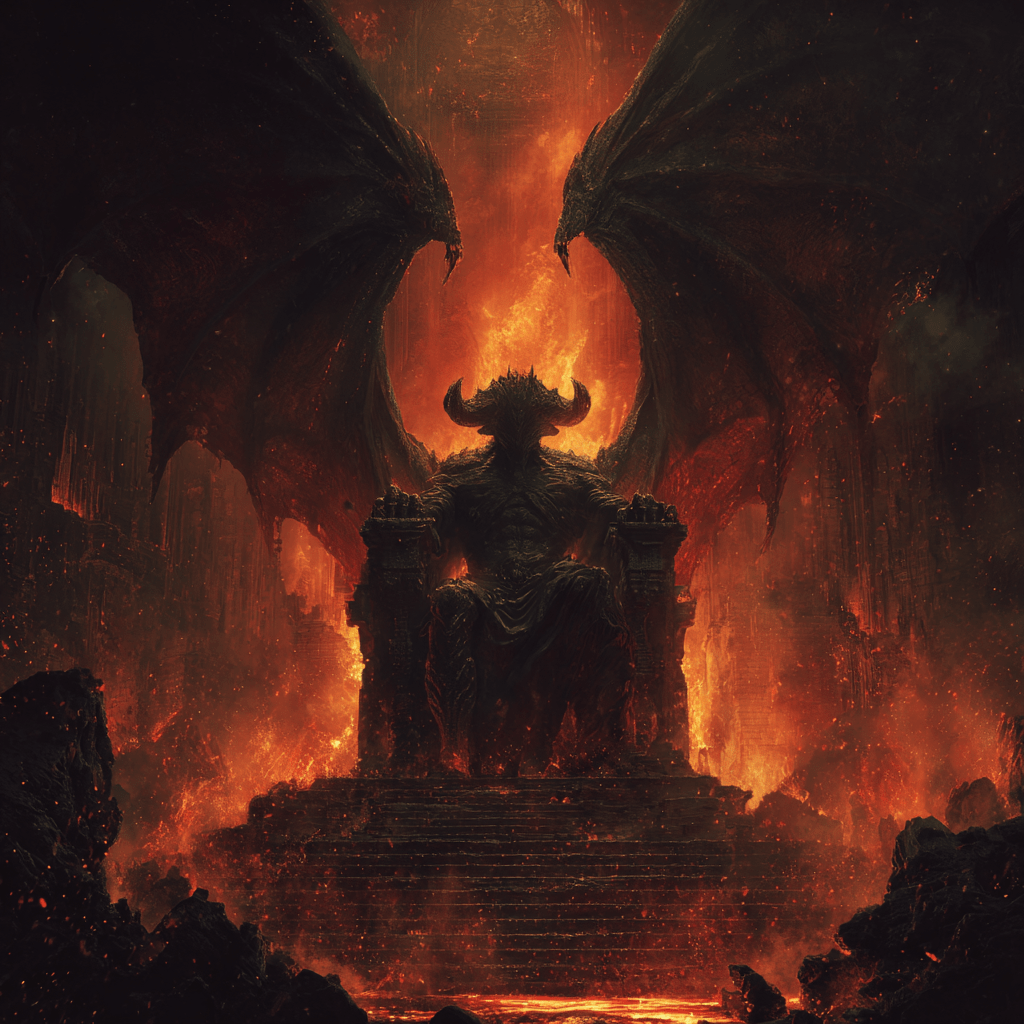
    Every now and again on social media, I will see someone with little more than a functioning brain stem post some variation of “So, since Satan punishes the bad people in hell, wouldn’t that make him the good guy?” as if it’s some sort of legendary “gotcha” moment. It’s a pretty deep thought… if you’re 12, edgy, and can’t read. As obvious as it may seem to Christians, however, this thought permeates pop culture. Look at the image at the top of this very post, for example. All I typed into an AI art website was “Satan in hell” and that’s what it spit out: and image of Satan on a throne. It’s such a prominent misconception that it even influences AI. But here’s what they all miss: hell was CREATED FOR Satan and his demons. He did not create it. He does not run it. And he’s certainly not “the preparator” of it.

    Matthew 25:41 states, “Then He will also say to those on his left, depart from Me, accursed ones, into the eternal fire which has been prepared for the devil and his angels.” This tells us two important things: 1) God prepared hell specifically for Satan and his demons, and 2) it wasn’t originally created for humans. We can know this because the phrase “and the wicked” is absent after the phrase “the devil and his angels.” If something is prepared FOR someone else, it goes to follow the person for whom it is prepared is not in charge of it. For example, I work over an hour from where I live and I’ve been staying at the same AirB&B for almost 3 years now. My host prepared the room for me. But if I decide to go completely off the deep end and disrespect her or her property, she reserves every right to kick me out and never let me back in. I love preparing food for a dear friend of mine at work. But if he decided to step out of line and suddenly start being nasty to me, I can take said food away and refuse to give him any more. And these examples are beneficial for both parties: I like having a place to sleep, and my host likes making money off the room. I love cooking, and my friend loves eating. How much more would this rule hold true to a place of punishment! A being going to a place of eternal torment prepared specifically for them definitely has no say in what takes place there.

    This point is driven home in Revelation 20:10: “And the devil who deceived them was thrown into the lake of fire and brimstone where the beast and the false prophet are also; and they will be tormented day and night forever and ever.” Scripture is abundantly clear. Satan is going to be punished at final judgment. He will be tormented for all eternity. He will not be overseeing the administration of punishments and reprimanding demons for not reaching their projected torture quotas for the week. He will be as tormented and miserable as the souls he’s tricked into following him.

    My grandfather, a pastor, used to say, “There will be a lot of people chasing preachers around in hell.” They’ll also be chasing around all the false prophets like Joseph Smith. Do I come across as harsh sometimes in this blog? I’m sure I do to people whose beliefs I’m dismantling, but it’s because I want to see them in heaven. I have life-saving information. I’d be an absolute monster not to pass it on.

  • I just returned from a medical missions trip to a communist third world country. I gave wound care, medical supplies, and all the energy I could muster within my exhausted frame for one main purpose: to fulfill the Great Commission, which is found in Matthew 28:18-20. It reads, “Then Jesus came to them and said, ‘All authority in heaven and on earth has been given to me. Therefore go and make disciples of all nations, baptizing them in the name of the Father and of the Son and of the Holy Spirit, and teaching them to obey everything I have commanded of you. And surely I am with you always, to the very end of the age.’” I won’t deny that I receive a substantial amount of praise for my work, but that isn’t at all why I do it. I want to point people to Christ and inspire them to choose him every day of their lives. I watched a woman to whom I provided care on this trip renounce witchcraft and give her life to Jesus. I author this blog for the very same reason. I want people to read their Bibles, weigh the evidence, and abandon any belief that stands between them and a relationship with Jesus. I’m not dismantling a group’s sacred text for kicks and giggles here. Believing in the Book of Mormon and listening to Joseph Smith’s teachings has eternal consequences. As we will see in today’s reading, he appears to broaden his definition of the “great and abominable church” to include any church that isn’t LDS. Therefore, according to him, I’m working for Satan.

    1 Nephi Chapter 14

    An angel tells Nephi of the blessings and cursings to fall upon the Gentiles. There are only two churches: the Church of the Lamb of God and the church of the devil. The saints of God in all nations are persecuted by the great and abominable church. The Apostle John will write concerning the end of the world. About 600-592 B.C.

    1: “And it shall come to pass, that if the Gentiles shall harken unto the Lamb of God in that day that he shall manifest himself unto them in word, and also in power, in very deed, unto the taking away of their stumbling blocks–“

    2: “And harden not their hearts against the Lamb of God, they shall be numbered among the seed of thy father; yea, they shall be numbered among the house of Israel; and they shall be a blessed people upon the promised land forever; they shall be no more brought down into captivity; and the house of Israel shall no more be confounded.”

    3: “And that great pit, which hath been digged for them by that great and abominable church, which was founded by the devil and his children, that he might lead away the souls of men down to hell– yea, that great pit which hath been digged for the destruction of men shall be filled by those who digged it, unto their utter destruction, saith the Lamb of God; not the destruction of the soul, save it be the casting of it into that hell which hath no end.”

    I’ve mentioned it before, but I think it bears mentioning again that the word “church” did not exist during the Old Testament period. “Church” is an exclusively Christian concept. When ancient Hebrews gathered together, they were referred to as “the assembly” or “the congregation.” While it would be interesting for me to delve into the Hebrew words for these, I’m afraid it wouldn’t do much good in this context, because Joseph Smith claimed the Book of Mormon was written in what he called “Reformed Egyptian,” a language that isn’t recognized by any scholar anywhere.

    Verses 4 through 8 can be summarized by stating that anyone who repents will be saved, but those whose hearts remain hardened will be brought down to destruction.

    9: “And it came to pass that he said unto me: Look, and behold that great and abominable church, which is the mother of abominations, whose founder is the devil.”

    10: “And he said unto me: Behold, there are save two churches only; the one is the church of the Lamb of God, and the other is the church of the devil; wherefore, whoso belongeth not to the church of the Lamb of God belongeth to that great church, which is the mother of all abominations; and she is the whore of all the earth.”

    Here is where it appears Smith has broadened his definition of the “great church, which is the mother of all abominations” to include any church that isn’t his. The Catholic, Protestant, and Orthodox churches would have to be included in this definition since he makes it clear there are only two churches. If the Book of Mormon is correct and the LDS church is the only true church, then that would mean all Christians throughout history would have taken the expressway straight to hell. That would beg the question of why God would not reveal a key and necessary truth for about 1,800 years. It makes no theological sense. We know that God is merciful (See Ephesians 2:4-5, Psalm 103:8, Lamentations 3:22-23, Micah 7:18, Hebrews 4:16, Romans 12:1, and James 2:13). We know that God is righteous (See Psalm 119:137, Deuteronomy 32:4, Psalm 48:10, Psalm 97:2, Isaiah 45:21, and John 17:25, for a few of MANY examples). We know that He is just (See Deuteronomy 32:4 again, Psalm 89:14, Isaiah 30:18, Micah 6:8, Proverbs 29:26). A merciful, righteous, and just God is not going to hide the key to salvation for centuries upon centuries then reveal it to one person on plates that He then supposedly took back to heaven, thereby removing all evidence for said key.

    11: “And it came to pass that I looked and beheld the whore of all the earth, and she sat upon many waters, and she had dominion over all the earth, among all nations, kindreds, tongues, and people.”

    12: “And it came to pass that I beheld the church of the Lamb of God, and its members were few, because of the wickedness and abominations of the whore who sat upon many waters; nevertheless, I beheld that the church of the Lamb, who were the saints of God, were also upon all the face of the earth; and their dominions upon the face of the earth were small, because of the wickedness of the great whore whom I saw.”

    More and more, we are seeing Smith’s “us vs them” mentality. He clearly hated Christians. What’s incredibly interesting, then, is the modern LDS insistence that they also be labeled as Christians. If they indeed believe they are the one true church, then why would they want to label themselves as something their own book condemns? Why would they want to identify themselves with a group that, by Joseph Smith’s insistence, was founded by Satan himself? For all the differences between Catholic, Protestant, and Orthodox Christians, the one thing we all affirm is the beliefs laid out in the Nicene Creed. Mormons do not.

    I will admit here that there are quarrels within Christianity between primarily Catholics and Protestants, which have been happening for centuries, and with deadly consequences. One doesn’t even have to look at history to see that. Just go to the comments section on social media and see Catholics and Protestants practically brawling on the sidewalk while the Orthodox Christians peer through their miniblinds in a house across the street to watch. I am of the opinion that the infighting is completely counterproductive and needs to stop. There are false doctrines in this world that are preventing people from walking with Jesus. We need to be educating ourselves on these doctrines and doing our best to lead by example and teach Biblical truths instead of wasting our time verbally slapping each other around.

    The next several verses describe the “great and abominable church” gathering forces to fight against the Mormon church, or the “church of the Lamb of God,” as Smith chooses to describe it. He also makes ample use of colorful language to describe the Christian church as we have seen in previous verses. These verses also talk about how God is going to punish the Christian church with “wars and rumors of wars.” I particularly enjoy verse 17, which really drives home Smith’s hatred of Christians:

    17: “And when the day cometh that the wrath of God is poured out upon the mother of harlots, which is the great and abominable church of all the earth, whose founder is the devil, then, at that day, the work of the Father shall commence, in preparing the way for the fulfilling of his covenants, which he hath made to his people who are of the house of Israel.”

    Seems like a perfectly nice guy.

    18: “And it came to pass that the angel spake unto me, saying: Look!”

    19: “And I looked and beheld a man, and he was dressed in a white robe.”

    20: “And the angel said unto me: Behold one of the twelve apostles of the Lamb.”

    21: “Behold, he shall see and write the remainder of these things; yea, and also many things which have been.”

    There are no prophecies anywhere in the Old Testament concerning any specific apostle, so it makes no sense there would be one in the Book of Mormon, either. As explained earlier, God is not going to reveal key truths then keep them hidden from everyone else. The Bible is the only Word of God. There is no other. The next several verses go on to describe what this apostle will write. Then there’s this:

    25: “But the things which thou shalt see hereafter thou shalt not write; for the Lord God hath ordained the apostle of the Lamb of God that he should write them.”

    In other words, Nephi is going to see all the same things John prophesies, but God only wants John to write about them. There is not a single instance of this in the Bible, and it makes no sense to even bring it up if he isn’t supposed to be writing about those things. He goes on to specifically name John as the apostle and reiterates that he (Nephi) will see things that he isn’t allowed to write about. It closes out with verse 30.

    30: “And now I make an end of speaking concerning the things which I saw while I was carried away in the Spirit; and if all the things which I saw were not written, the things which I have written were true. And thus it is. Amen.

    You will not find verses in the Bible that declare itself to be true. This is because it doesn’t need to. A good man doesn’t need to declare to you that he is good; he simply is. An honest man doesn’t need to keep telling you he is honest; he is simply honest, and the truth of his words is observed. The truth of the Bible does not need to be declared in itself; its truth is inherent.

    Stay tuned for more, ladies and gents.

  • You should all be grateful that the wind where I live is out of control today, because if it wasn’t, I’d be at the gun range gleefully destroying targets and not trudging through the Book of Mormon, so you all don’t have to. So here I am instead, taking a different kind of aim at a different kind of target: 1 Nephi Chapter 13. There is quite a lot to unpack within the 42 verses that make up this chapter. We will see Smith’s clear hatred of Catholics. We will see more of his white supremacist sentiments. We will also see a woefully common and completely ignorant claim that continues to rear its obnoxious head on a regular basis: that the Catholic church removed books from the Bible. As you can tell from that sentence, I have quite a lot to say on that topic. I will be citing “How We Got the Bible” by Neil R. Lightfoot throughout this post, as it’s an excellent source on the origins of Scripture and its canonization. It was first recommended to me by my oldest brother, Dr. Jonathan Morgan of Indiana Wesleyan University, and I’ve since read it and built upon the foundation of knowledge it laid. I would highly recommend it for anyone curious about that topic. And now, without further delay, let’s delve into today’s reading.

    1 Nephi Chapter 13

    Nephi sees in a vision the church of the devil set up among the Gentiles, the discovery and colonizing of America, the loss of many plain and precious parts of the Bible, the resultant state of gentile apostasy, the restoration of the gospel, the coming forth of latter-day scripture, and the building up of Zion. About 600-592 B.C.

    1: “And it came to pass that the angel spake unto me, saying: Look! And I looked and beheld many nations and kingdoms.

    2: “And the angel said unto me: What beholdest thou? And I said: I behold many nations and kingdoms.”

    3: “And he said unto me: These are the nations and kingdoms of the Gentiles.”

    4: “And it came to pass that I saw among the Gentiles the formation of a great church.”

    5: “And the angel said unto me: Behold the formation of a church which is most abominable above all other churches, which slayeth the saints of God, yea, and tortureth them and bindeth them down, and yoketh them with a yoke of iron, and bringeth them down into captivity.”

    6: “And it came to pass that I beheld this great and abominable church; and I saw the devil that he was the founder of it.”

    This passage is very clearly talking about the Catholic Church, as that is the oldest church founded. There is some debate over this idea, as Catholics believe their church began immediately at the Day of Pentecost and Peter was the first Pope. Others would say these early churches at Christianity’s inception were simply Christian and not necessarily Catholic. None of this really matters, however, in the context of this chapter in 1 Nephi; no matter what stance one takes, it’s sill obvious the Catholic Church is being discussed here because it was the first association of Christian churches that officially organized themselves with uniform doctrine, teachings, and practices.

    While it’s incredibly well-documented that the Catholic Church became corrupt over time (hello, Protestant Reformation!), it’s quite the leap to assert the devil founded the church. The first four centuries of the Catholic Church, known as the Classical period of Christianity, produced all the foundational doctrines that are so essential to Christianity that one cannot claim to be one without affirming these beliefs. These include the doctrine of the Trinity (this is a major one), the atonement, and baptism, just to name a few. The Nicene Creed (which Mormons do not affirm) is an excellent summary of Christian beliefs and came during those first four centuries. While the early church fathers were by no means perfect, every Christian alive owes them a certain amount of respect for grappling with these issues, digging into Scripture for clarity, and laying the foundations for all who came after them. I’m unapologetically Protestant to my core, and even I find the idea that Satan started the Catholic Church to be an abhorrent declaration. Read “Classical Christian Doctrine: Introducing the Essentials of the Ancient Faith” by Ronald E. Heine for more information on this interesting topic.

    7: “And I also saw gold, and silver, and silks, and scarlets, and fine-twisted linen, and all manner of precious clothing; and I saw many harlots.”

    8: “And the angel spake unto me, saying: Behold the gold, and the silver, and the silks, and the scarlets, and the fine-twined linen, and the precious clothing, and the harlots, are the desires of this great and abominable church.”

    9: “And also for the praise of the world do they destroy the saints of God, and bring them down into captivity.”

    As stated before, it’s well-known how corrupt the powers of the Catholic Church became. It was that very corruption that necessitated the Protestant Reformation. It is true they punished and executed dissenters. William Tyndale, who translated much of the Bible into English, was charged with heresy and executed in 1536. Martin Luther had to go into hiding due to threats from the Church. These are just two of many examples. Again, though, insisting the devil founded a church because its later leaders became corrupt is nonsensical. If that were true, then we would also have to say that every single other institution on earth was founded by him.

    10: “And it came to pass that I looked and beheld many waters; and they divided the Gentiles from the seed of my brethren.”

    11: “And it came to pass that the angel said unto me: Behold the wrath of God is upon the seed of thy brethren.”

    12: “And I looked and beheld a man among the Gentiles, who was separated from the seed of my brethren by the many waters; and I beheld the Spirit of God, that it came down and wrought upon the man; and he went forth upon the many waters, even unto the seed of my brethren, who were in the promised land.”

    13: “And it came to pass that I beheld the Spirit of God, that it wrought upon other Gentiles; and they went forth out of captivity, upon the many waters.”

    14: “And it came to pass that I beheld many multitudes of the Gentiles upon the land of promise; and I beheld the wrath of God, that it was upon the seed of my brethren; and they were scattered before the Gentiles and were smitten.”

    15: “And I beheld the Spirit of the Lord, that it was upon the Gentiles, and they did prosper and obtain the land for their inheritance; and I beheld that they were white, and exceedingly fair and beautiful, like unto my people before they were slain.”

    This should go completely without saying, but Middle Eastern people were not “white, and exceedingly fair.” We see yet again Smith’s attitude that whiteness is automatically associated with virtue and God’s favor. There is absolutely zero reason to bring up skin color. There’s only one instance I can think of in the Bible where skin color is mentioned (Song of Solomon 1:5), and that’s a love poem in which Solomon gushes about the beauty of his lover. Yet only 13 chapters into the Book of Mormon, skin color has been mentioned at least three times I can recall off the top of my head.

    Some time ago, when I first became interested in investigating Mormonism, I stumbled across an incredibly fascinating article in the LDS publication “Dialogue.” It’s a journal for LDS academics to discuss evidence (or lack thereof) for the Book of Mormon. The article, titled “Simply Implausible: DNA and a Mesoamerican Setting for the Book of Mormon,” delves deeply into the lack of Middle Eastern DNA in indigenous populations in the Americas. This is a significant finding because if the Book of Mormon narrative is true and ancient Hebrews migrated to the Americas, then there would be DNA evidence in Native American populations. Since there is absolutely none, the only reasonable conclusion to draw is what’s described here simply didn’t happen. The author, Thomas Murphy, also details the intellectual bullying that took place as a result of his findings. He was even threatened with church discipline over it.

    I have heard it said by some that God must have removed the evidence because He wants people to have faith in Him and not physical findings. Now, I will confess here that I’m not sure how prominent that line of thinking is in LDS circles, as I’ve not discussed this at great length with a large number of them. So, if this is more of a fringe idea, forgive me. However, I think it needs to be said that the God of the Bible, who says, “Come, let us REASON together” in Isaiah 1:18 (emphasis mine) is not going to demand we believe in something then purposely remove every single piece of evidence that would enable that belief. We are rational, logical beings created in the image of God, so it goes to follow that He is those things as well. While a few theological concepts may be beyond our grasp (the Trinity, for example), we step out in faith and believe them because there is so much evidence for so many other things. Faith with no evidence isn’t faith at all; it’s blind belief fueled by indoctrination.

    Verses 16 through 19 describes battling between the different people in the Americas. Verses 20 through 25 introduce the Book of Mormon.

    26: “And they go forth by the hand of the twelve apostles of the Lamb, from the Jews unto the Gentiles, thou seest the formation of that great and abominable church, which is most abominable above all other churches; for behold, they have taken away from the gospel of the Lamb many parts which are plain and most precious; and also many covenants of the Lord have they taken away.”

    27: “And all this have they done that they might pervert the right ways of the Lord, that they might blind the eyes and harden the hearts of the children of men.”

    No, this absolutely did not happen. This is a very common claim based upon willful ignorance and a disdain for Christianity in general, smugly said as some sort of “gotcha” while they throw their shoulders out from repeatedly patting themselves on the back for being so much smarter than us silly Christians. The canonization of Scripture is very well explained in the book I mentioned earlier, “How We Got the Bible.”

    When we’re talking about the Bible, “canon” refers to the books written with divine authority. A book’s canonicity depends on its authority. Paul’s letters, for example, had authority right away due to his status as an apostle. They did not become considered canon until it was included in a list of writings recognized as having divine authority.

    By the time of Jesus, the Old Testament canon was already fixed and recognized. We know this because Jesus and his apostles often quoted from the Old Testament, usually prefixing the quotes with “it is written.” The books of the Hebrew Bible are the same as the Christian Bible’s Old Testament. Jesus even alluded to this arrangement and what books are contained in it. He spoke of the time “from the blood of Abel to the blood of Zechariah between the altar and the sanctuary.” (Luke 11:51, Matt 23:35). The first martyr of the OT was Abel; the last was Zechariah in Chronicles. The Hebrew Bible places Chronicles as the last book, so Jesus was referring to everything in between.

    Further evidence for Old Testament canon comes from Josephus, a 1st century Jewish historian. He wrote a defense of the Hebrew Bible in 95 A.D. titled, “Against Apion.” In it, he points out the number of books recognized as having divine authority are 22. They combined their books, arranged them, and enumerated them differently than we do. But all that material is the same as the 39 OT books that we have today. Furthermore, the time covered in these books is expressly limited. Josephus believed the canon extended from Moses to Artaxerxes (464-424 B.C.) This corresponds to the Jewish belief that prophetic inspiration ended with Malachi, a contemporary of Ezra and Nehemiah. The Jews took their sacred text very seriously, to the point where none of them would even dream of adding or taking away from it. It is reasonable to believe, then, that what we have now as the Old Testament is exactly as the ancient Hebrews intended and recognized as divine.

    As far as the New Testament canon goes, we know that the earliest Christians didn’t have one. We do know Old Testament writings and letters from Apostles were read in church initially. Divinely inspired men, such as Paul, wrote letters to the different churches containing regulations and teachings. These letters were then gathered into collections. The collections of letters between the different churches varied slightly, but only because they were collected at different times and places. Lists of accepted New Testament books began to appear in the 2nd century.

    The earliest example we have is the Muratorian Fragment, named after the man who discovered it and published it in the 18th century. Part of it has been lost. It starts with Luke but lists that as the 3rd Gospel, so it’s assumed the first 2 were the missing piece. John, Acts, 13 letters of Paul, Jude, two letters of John, and Revelation were then listed. Not included were Hebrews, James, 1 and 2 Peter, and perhaps 3 John. Included are the Wisdom of Solomon and the Apocalypse of Peter. Of the latter, it was written “some of our people” didn’t want it read in church. At the end were listed books that were considered heretical.

    In the 3rd century, Origen, an early Christian scholar and writer, added his input. He listed the Four Gospels, Acts, 13 letters of Paul, 1 Peter, 1 John, and Revelation. He wasn’t entirely sure about Hebrews, James, 2 Peter, 2 and 3 John. He did often quote from Hebrews but acknowledged that not all churches accepted it. He did list the canon differently in his “Homilies of Joshua,” but later went on to list the 27 books of the New Testament we have today.

    The canonization of the New Testament came to a close in the 4th century, as recorded by early church historian Eusebius. He distinguished 3 categories of books: those universally acknowledged, those disputed, and those universally rejected. Books acknowledged by all included the Four Gospels, Acts, 14 letters of Paul, 1 John, 1 Peter, and Revelation. Disputed books included James, Jude, 2 Peter, 2 and 3 John, but he noted they were “recognized by the majority.” The rejected books included Shepherd of Hermas, The Epistle of Barnabas, and The Teachings of the Apostles. In A.D. 367, Athanasius of Alexandria published a list of the 27 books of the NT that we have today, noting, “These are the springs of salvation… Let no one add anything to them or take anything away from them.”

    As the Author of “How We Got the Bible” states at the end of chapter 14, “No church or council made the canon of Scripture. No church by its decrees gave to or pronounced on the Books of the Bible their infallibility. The Bible owes its authority to no individual or group. The church does not control the canon, but the canon controls the church. The authority is inherent in Scripture itself and was simply recognized.”

    I told you all I had quite a lot to say about this topic! As you can see from history, no books were removed from the canon. Books were rejected for good reason. Early Christians were not naive or ignorant regarding what constituted Scripture. There are repeated warnings in the New Testament about false teachers, so it’s clear the early Christians were expected to use discernment.

    Verses 28 through 29 basically repeat the same things in verses 26 and 27. 30 through 34 discusses the goings on of his descendants in America.

    35: “For behold, saith the Lamb: I will manifest myself unto thy seed, that they shall write many things which I shall minister unto them, which shall be plain and precious (What in the world is the obsession with that phrase? It’s occurred in this chapter 9 times); and after thy seed shall be destroyed, and dwindle in unbelief, and also the seed of thy brethren, behold, these things shall be hid up, to come forth unto the Gentiles, by the gift and power of the Lamb.”

    36: “And in them shall be written my gospel, saith the Lamb, and my rock and my salvation.:

    No. Absolutely not. Galatians 1:8 states, “But even if we, or an angel from heaven, should preach to you a gospel contrary to what we have preached to you, let him be accursed!” We have the Four Gospels. That’s it. Do not pass go. Do not collect $200. Go to jail, for good measure.

    The rest of this chapter basically prophesies the spreading of the Book of Mormon and uses its characteristic repetitive language to describe how everyone who believes in it will be saved. I don’t feel the need to expound upon any of that at this juncture, because 1) I’ve made my points pretty clear and addressed the major issues in this chapter, and 2) I’m doggedly tired and want nothing more than to make some tea and do something that doesn’t require any critical thinking. “For of making many books there is no end, and much study is a weariness to the flesh” (Ecclesiastes 12:12). Stay tuned, ladies and gents! I’ll be back in a day or two.

  • The charge of racism in LDS theology and history has long been a topic of discussion. Based upon my previous post on 1 Nephi chapter 11 and now chapter 12, I think it’s fair to say the Book of Mormon reflects the racism of Joseph Smith’s time by associating whiteness with virtue and darkness with depravity, and there’s nothing subtle about this message. This will become more evident in this chapter and others. In addition to this, we will also see the Book of Mormon make claims that are not only not supported by evidence but contradict it outright. I could go down the rabbit hole with genetics and archeological findings in the Americas, but that will have to wait, as it is somewhat out of the scope of this particular chapter. Here we see Nephi record prophecies that involve his descendants and those of his brothers.

    1 Nephi Chapter 12

    Nephi sees in vision the land of promise; the righteousness, iniquity, and downfall of its inhabitants; the coming of the Lamb of God among them; how the Twelve Disciples and the Twelve Apostles will judge Israel; and the loathsome and filthy state of those who dwindle in unbelief. About 600-592 B.C.

    1: “And it came to pass that the angel said unto me: Look, and behold thy seed, and the seed of thy brethren. And I looked and beheld the land of promise; and I beheld the multitudes of people, yea, even as it were in number as many as the sand of the sea.”

    In a previous post of mine, “An Implausible Discovery,” I point out that there was only one promised land in the Bible, and Nephi and his family would have already been living in it when this was purported to have been written. The “land of promise” mentioned here, of course, turns out to be America. Also, the phrase “as many as the sand of the sea” appears in the Old Testament when God promises Abraham of how numerous his descendants will be. See Genesis 22:17. So, it appears that’s another phrase taken from the Bible.

    2: “And it came to pass that I beheld multitudes gathered together to battle, one against the other; and I beheld wars, and rumors of wars, and great slaughters with the sword among my people.”

    The phrase “rumors of wars” is used by Jesus in discussing the end times (Matthew 24:6 and Mark 13:7), so it’s very strange that it’s used here in an Old Testament era.

    3: “And it came to pass that I beheld many generations pass away, after the manner of wars and contentions in the land; and I beheld many cities, yea, even that I did not number them.”

    4: “And it came to pass that I saw a mist of darkness on the face of the land of promise; and I saw lightnings, and I heard thunderings, and earthquakes, and all manner of tumultuous noises; and I saw the earth and the rocks, that they rent; and I saw mountains tumbling into pieces; and I saw the plains of the earth, that they were broken up; and I saw many cities that were sunk; and I saw many that were burned with fire; and I saw many that did tumble to the earth, because of the quaking thereof.”

    If these things were true, there would be archeological evidence of these events. There is none. Anywhere. At all. I will happily delve more into this when these settlements and wars are discussed in much greater detail later on in the Book of Mormon.

    5: “And it came to pass after I saw these things, I saw the vapor of darkness, that it passed from off the face of the earth; and behold, I saw multitudes who had not fallen because of the great and terrible judgment of the Lord.”

    6: “And I saw the heavens open, and the Lamb of God descending out of heaven; and he came down and showed himself unto them.”

    So, it’s being claimed that Jesus visited the USA. Ok, then.

    7: “And I also saw and bear record that the Holy Ghost fell upon twelve others; and they were ordained of God, and chosen.”

    8: “And the angel spake unto me, saying: Behold the twelve disciples of the Lamb, who are chosen to minister unto they seed.”

    The claim here seems to be that God chose 12 additional disciples for a different continent. Even if one were to believe the Book of Mormon, what sense does this make? The Twelve Apostles in the New Testament accompanied Jesus during his ministry then continued preaching after his death and resurrection. If he really did appear to people on this continent, why would he need 12 more disciples, and why would he choose people who weren’t even a part of his original ministry? If any of this had actually happened, then the Book of Mormon would complement the Bible perfectly. There would be no inconsistencies, contradictions, or obvious plagiarisms. There would be many different manuscripts that would bear witness to the Book of Mormon and what it claims. But as we have seen thus far and will continue to see, there are problems galore. LDS theology is rife with unbiblical teachings.

    9: “And he said unto me: Thou rememberest the twelve apostles of the Lamb? Behold they are they who shall judge the twelve tribes of Israel; wherefore, the twelve ministers of thy seed shall be judged of them; for ye are the house of Israel.”

    There is no judgment by the Twelve Apostles in Scripture. The only reference we have of anyone besides God passing judgment is 1 Corinthians 6:23, when Paul asks, “Do you not know that the saints will judge the world? And do you not know that we are to judge angels?” This passage is cryptic, and there are several possible interpretations. However, the Bible makes it clear the God is the ultimate judge. See Romans 14:10-12, Hebrews 12:23, James 4:12, 2 Corinthians 5:10, and John 5:22. If all we have is a single, odd, cryptic verse in the New Testament implying Christians may play a role in judgement, it’s inconsistent with the Bible to claim the Apostles will judge Israel.

    10: “And these twelve ministers who thou beholdest shall judge thy seed. And, behold, they are righteous forever; for because of their faith in the Lamb of God their garments are made white in his blood.”

    11: “And the angel said unto me: Look! And I looked, and beheld three generations pass away in righteousness; and their garments were white even like unto the Lamb of God. And the angel said unto me: These are made white in the blood of the Lamb, because of their faith in him.”

    12: “And I, Nephi, also saw many of the fourth generation who passed away in righteousness.”

    Using whiteness to illustrate the purification from sins is often used in the Bible. It is used in a spiritual sense. See Isaiah 1:18, and Psalm 51:7. When used as a physical description, God is the subject. Daniel 7:9 describes the Ancient of Days and His “vesture was like white snow, and the hair of His head like pure wool.” Revelation 1:14 describes the hair of Jesus as “white like wool, as white as snow.” It is not used to describe skin color unless it’s talking about leprosy. It is never used to describe skin tone as a sign of virtue. This is an important concept for the end of this chapter.

    Verses 13-19 describe the descendants of Nephi fighting against the descendants of his brothers.

    20: “And it came to pass that I beheld, and saw the people of the seed of my brethren that they had overcome my seed; and they went forth in multitudes upon the face of the land.”

    21: “And I saw them gathered together in multitudes; and I saw wars and rumors of wars among them; and in the wars and rumors of wars I saw many generations pass away.”

    22: “And the angel said unto me: Behold these shall dwindle in unbelief.”

    23: “And it came to pass that I beheld, after they had dwindled in unbelief they became a dark, and loathsome, and a filthy people, full of idleness and all manner of abominations.”

    And with that, we Joseph Smith’s thoughts on Indigenous people. There is no other way to read this. If he believed that ancient Jews migrated to the Americas, then he believed they were the ancestors of Native Americans, which he is describing here. This absolutely reflects the attitudes of white people towards Native Americans at that time, who were widely known as “savages.” Charming.

  • Do I have to? No. But am I going to so I can compare and contrast this with the Bible, so you all don’t have to do it yourselves? Absolutely. If you haven’t done so, I would encourage you to read my previous post, “New Testament Language in an Old Testament Era” because this one will build quite a lot off of the principles laid out there, and I don’t particularly enjoy repeating myself when it isn’t necessary. You might also check out “This Vision Seems Awfully Familiar…” because part of that is rehashed in this chapter. 1 Nephi 11 also contains several prophecies that you won’t find in the Old Testament and are simply descriptions of what took place in the New Testament, much like Lehi’s visions in 1 Nephi 10. I will skim over the verses here that mention John the Baptist, Jesus’s baptism, and the crucifixion because those were extensively addressed in my previous post. I also won’t be delving too deeply into the vision with the tree of life because that was also addressed previously.

    1 Nephi Chapter 11

    Nephi sees the Spirit of the Lord and is shown the tree of life. He sees the mother of the Son of God and learns of the condescension of God. He sees the baptism, ministry, and crucifixion of the Lamb of God. He sees also the call and ministry of the Twelve Apostles of the Lamb. About 600-592 B.C.

    The first 11 verses consist of Nephi asking the Spirit of the Lord to see the visions that his father has seen and additional prophecies. He is then shown the tree of life and expresses his desire to know what it represents.

    12: “And it came to pass that he said unto me: Look! And I looked as if to look upon him, and I saw him not; for he had gone from before my presence.”

    13: “And it came to pass that I looked and beheld the great city of Jerusalem, and also other cities. And I beheld the city of Nazareth; and in the city of Nazareth I beheld a virgin, and she was exceedingly fair and white.”

    14: “And it came to pass that I saw the heavens open; and an angel came down and stood before me; and he said to me: Nephi, what beholdest thou?”

    15: “And I said unto him: A virgin, most beautiful and fair above all other virgins.”

    The virgin birth was prophesied in Isaiah 7:14. That is the only time it is mentioned in the Old Testament. What’s bizarre about this particular passage is that Nephi knew immediately she was a virgin just by looking at her, and we have no descriptions at all in the Old or New Testaments of Mary’s physical appearance. The most obvious blunder here, of course, is that Mary was Middle Eastern. She would not have been “exceedingly fair and white.” We have no idea if she was “most beautiful and fair above all other virgins.” This begs the question of why Joseph Smith thought it necessary to describe her in this way. Was physical beauty a requirement for God to choose her to be the mother of Jesus? Is there a racist undertone of her whiteness being some sign of virtue and worthiness? God certainly doesn’t see it that way, as evidenced in 1 Samuel 16:7, when he was sent to anoint a new king over Israel and was certain one of David’s tall, handsome brothers was surely the one: “But the LORD said to Samuel, “Do not look at his appearance or at the height of his stature, because I have rejected him; for God sees not as man sees, for man looks at the outward appearance, but the Lord looks at the heart.” We see this principle again in John 7:24, when Jesus says, “Do not judge according to appearance, but judge with righteous judgment.”

    16: “And he said unto me: Knowest thou the condescension of God?”

    17: “And I said unto him: I know that he loveth his children; nevertheless, I do not know the meaning of all things.”

    18: “And he said unto me: Behold, the virgin whom thou seest is the mother of the Son of God, after the manner of the flesh.”

    “The mother of the Son of God” is a very interesting and telling turn of phrase. Since almost the beginning of Christianity, Mary was called “Theotokos,” which means “bearer or mother of God.” This stems, of course, from the belief in the Trinity, a doctrine so foundational to Christianity that one cannot claim to be a Christian while denying it. This term acknowledges the infant to which Mary gave birth was divine. There was some controversy in the 5th century over its use, namely from Nestorius, a monk with the church at Antioch. He was later appointed bishop of Constantinople in 428 AD but was removed in 431 AD after being accused of teaching heretical doctrines about Christ. Others who objected to the use of this term instead suggested “Anthropotokos,” which means “Bearer of Man.” This is naturally problematic because Mary did not give birth to a mere human. Nestorius preferred the term “Christotokos” which would mean “Bearer of Christ.” He believed this encompassed both the divine and human nature of Christ. Cyril of Alexandria, on the other hand, was completely baffled that this was even a point of discussion. In his Letter 1 to the Monks of Egypt, he stated, “I am amazed there are some who are extremely doubtful whether the holy Virgin should be called Mother of God or not. For if our Lord Jesus Christ is God, then surely the holy Virgin who gave him birth must be God’s mother.” He goes on to describe mothers as giving birth to both a human and a soul before concluding, “If anyone maintained that anyone’s mother was “mother of flesh” and not “mother of soul,” he would be talking nonsense. For what she has produced is one living being, a composite of two dissimilar elements, but a single human being, with each element retaining its own nature.” The debate raged on until an ecumenical council met at Chalcedon in 451 AD and settled the matter. She has been called Theotokos ever since. For more information, see chapter 8 in “Classical Christian Doctrine: Introducing the Essentials of the Ancient Faith” by Ronald E. Heine.

    While the information I just presented may seem dry, it is necessary to point it out because it means Joseph Smith appears to be identifying with a term promoted by someone who was denounced as a heretic. He was going against not just the Bible, but also around 1,700 years of Christian theology and tradition. I will gladly explain the doctrine of the Trinity, but it will have to be a separate post. It is outside the scope of this particular discussion.

    19: “And it came to pass that I beheld that she was carried away in the Spirit; and after she had been carried away in the Spirit for the space of a time the angel spake unto me, saying: Look!”

    20: “And I looked and beheld the virgin again, bearing a child in her arms.”

    21: “And the angel said unto me: Behold the Lamb of God, yea, even the Son of the Eternal Father! Knowest thou the meaning of the tree which thy father saw?”

    Using the phrase “Eternal Father” contradicts Joseph Smith’s own teaching that God was once a man. In his “King Follet Discourse,” he states, “God himself was once as we are now, and is an exalted man, and sits enthroned in yonder heavens! That is the great secret…. It is the first principle of the Gospel to know for a certainty the Character of God, and to know… that he was once a man like us…. Here, then, is eternal life – to know the only wise and true God; and you have got to learn how to be Gods yourselves… the same as all Gods have done before you…” This is documented in multiple sources. The glaring problem, of course, is that nothing with a beginning can be called eternal.

    Verses 22-25 discuss the meaning of the vision of the tree of life. Basically, the rod of iron was the word of God, and the waters and the tree represented God’s love. Verses 26 and 27 talk about John the Baptist and Jesus’s baptism, which have been previously discussed.

    26: “And I beheld that he went forth ministering unto the people, in power and great glory; and the multitudes were gathered together to hear him; and I beheld they cast him out from among them.”

    This doesn’t contradict necessarily contradict Biblical prophecies about Jesus. We read in Isaiah 53 he was “despised and forsaken by men,” and “He was oppressed and He was afflicted…” Unfortunately for LDS followers, this one instance of not being problematic does not cancel out the flaming dumpster fire of other problems in the Book of Mormon.

    29: And I also beheld twelve others following him. And it came to pass that they were carried away in the Spirit from before my face, and I saw them not.”

    There are no Old Testament prophecies concerning the Twelve Apostles. I suspect this is simply another effort on Smith’s part to make his scriptures appear as giving accurate prophecy.

    30: “And it came to pass that the angel spake unto me again, saying: Look! And I looked, and I beheld the heavens open again, and I saw angels descending upon the children of men; and they did minister unto them.”

    No.

    31: “And he spake unto me again, saying: Look! And I looked, and I beheld the Lamb of God going forth among the children of men. And I beheld multitudes of people who were sick, and who were afflicted with all manner of diseases, and with devils and unclean spirits; and the angel spake and showed all these things unto me. And they were healed by the power of the Lamb of God; and the devils and the unclean spirits were cast out.”

    Isaiah 61:1-2 is a foreshadowing of Jesus’s ministry. More descriptions of his ministry in a spiritual sense can be found in Isaiah 9. Isaiah 35:4-6 speaks of the miracles he would perform. There is nothing regarding casting out demons, but that could be inferred by all other prophecies concerning Jesus. Verses 32 and 33 are about the crucifixion.

    34: “And after he was slain I saw the multitudes of the earth, that they were gathered together to fight against the apostles of the Lamb; for thus were the twelve called by the angel of the Lord.”

    Nowhere in Scripture are the Twelve Apostles called the apostles of the Lamb.

    35: “And the multitude of the earth was gathered together; and I beheld that they were in a large and spacious building, like unto the building my father saw. And the angel of the Lord spake unto me again, saying: Behold the world and the wisdom thereof; yea, behold the house of Israel hath gathered together to fight against the twelve apostles of the Lamb.”

    36: “And it came to pass that I saw and bear record, that the great and spacious building was the pride of the world; and it fell, and the fall thereof was exceedingly great. And the angel of the Lord spake unto me again, saying: Thus shall be the destruction of all nations, kindreds, tongues, and people, that shall fight against the twelve apostles of the Lamb.”

    There is nothing even closely resembling these last two verses anywhere in the Bible. They were all horribly persecuted and died terrible deaths, but nothing about verses 35 and 36 make any sense. The world does not fight against the Twelve Apostles. It fights against God and his principles. It mocks Jesus and everything he stood for. It twists Scripture to try to force it to align with whatever sin it wants to affirm. Its anger is not ultimately directed at us. John 15:18 states, “If the world hates you, remember that it hated me first.”

  • Various insights come to me at the most random times. This evening, I was relishing the aroma of the apple pie syrup I was making while the rain fell softly on my kitchen windowpanes. Between the occasional stirs of the simmering amber concoction, I perused chapter 10 of 1 Nephi. Besides the seeming plagiarism of New Testament passages, something else jumped out at me: the use of the phrase “Holy Ghost.” Some translations use the phrase “Holy Spirit,” but the observation remains the same. While the Holy Spirit is absolutely present and active in the Old Testament, that particular phrase is only used three times: once in Psalm 51:11, and twice in Isaiah 63:10-11. In all other parts of the Old Testament, he is called “the Spirit of the Lord,” “the Spirit of God,” or simply “Spirit.” Thus far in the Book of Mormon, that phrase has appeared numerous times, which is a very peculiar difference from the Bible. Given the evidence I’ve presented in my post “This Vision Seems Awfully Familiar” of Smith’s plagiarism, I think it is perfectly reasonable to conclude that phrase and other passages that match the Bible are because he was attempting to make his book appear as if the prophecies it contains are accurate. However, I’m not here to tell you what to think. Review the evidence, then decide for yourself.

    1 Nephi, chapter 10

    Lehi predicts that the Jews will be taken captive by the Babylonians. He tells of the coming among the Jews of a Messiah, a Savior, a Redeemer. Lehi also tells of the coming of the one who should baptize the Lamb of God. Lehi tells of the death and resurrection of the Messiah. He compares the scattering and gathering of Israel to an olive tree. Nephi speaks of the Son of God, of the gift of the Holy Ghost, and of the need for righteousness. About 600-592 B.C.

    1: “And now I, Nephi, proceed to give an account upon the plates of my proceedings, and my reign and ministry; wherefore, to proceed with mine account, I must speak somewhat of the things of my father, and also of my brethren.”

    2: “For behold, it came to pass after my father had made an end of speaking the words of his dream, and also of exhorting them to all diligence, he spake unto them concerning the Jews–“

    3: “That they should be destroyed, even that great city Jerusalem, and many be carried away captive into Babylon, according to the own due time of the Lord, they should return again, yeah, even be brought back out of captivity; and after they should be brought back out of captivity they should possess again the land of their inheritance.”

    Isaiah 39:6-7 predicts “all that is in hour house…shall be carried to Babylon; nothing shall be left” and “… some of your sons… shall be taken away; and they shall become officials in the palace of the king of Babylon.” Jeremiah 25:11-12 is more specific, saying they would be exiled for 70 years. The prophesy of their return was fulfilled when King Cyrus of Persia allowed the exiled Judeans to return to Jerusalem and build the second temple.

    4: “Yea, even six hundred years from the time that my father left Jerusalem, a prophet would the Lord God raise up among the Jews– even a Messiah, or, in other words, a Savior of the world.”

    5: “And he also spake concerning the prophets, how great a number had testified of these things, concerning this Messiah, of whom he had spoken, or the Redeemer of the world.”

    6: “Wherefore, all mankind were in a lost and in a fallen state, and ever would they be save they should rely on this Redeemer.”

    Isaiah 7:14 predicts the Virgin Birth and his name would be Immanuel, which means “God with us.” Isaiah 11:1 and Jeremiah 23:5-6 both prophesied that Christ would be a descendant of David. Micah 5:2 tells us his birth will be in Bethlehem. The whole chapter of Isaiah 53 describes Christ as a suffering servant who was “pierced through for our transgressions.” It goes into great detail describing the weight of everyone’s sins and the atonement. Psalm 22 also predicts his suffering, opening with the well-known phrase Jesus said on the cross, “My God, my God, why hast Thou forsaken me?” The chapter goes on to describe the suffering: “They pierced my hands and my feet… They divide my garments among them, and for my clothing they cast lots.” See Matthew 27:35 and John 19:23-24 to see the fulfillment of that prediction. His resurrection is also foretold in Psalm 16:10, Isaiah 53, and Hosea 6:1-2. These are only a few of MANY prophecies concerning Christ. Listing them all would require more time than I have, but you should get the idea. What’s strange to note here are the terms the Book of Mormon uses to prophesy concerning Jesus. “Redeemer” is not used in any Old Testament predictions of his coming. Neither is “savior.” While these words are used to describe God, they are not applied specifically to Jesus until the New Testament.

    7: “And he spake also concerning a prophet who should come before the Messiah, to prepare the way of the Lord–“

    8: “Yea, even he should go forth and cry in the wilderness: Prepare ye the way of the Lord, and make his paths straight; for there standeth one among you whom ye know not; and he is mightier than I, whose shoe’s latchet I am not worthy to unloose. And much spake my father concerning this thing.”

    Isaiah 40:3-4 alludes to John the Baptist as a voice calling out to prepare the way for the Lord. Malachi 3:1 also speaks of a messenger coming before the Messiah. However, it is not prophesied that he will refer to him as someone “whose shoe’s latchet I am not worthy to unloose.” That does not appear until the New Testament. See John 1:27, Matthew 3:11, and Mark 1:7.

    9: “And my father said he should baptize in Bethabara, beyond the Jordan; and he also said he should baptize with water; even that he should baptize the Messiah with water.”

    10: “And after he had baptized the Messiah with water, he should behold and bear record that he had just baptized the Lamb of God, who should take away the sins of the world.”

    Jesus’ baptism was not explicitly foretold in any Old Testament prophecies. It was not described as a physical baptism of water, but as a pouring out of the Spirit. This can be seen in Isaiah 11:2 and again in 42:1. It is also described in Psalm 2:7. No baptism appears in any of these descriptions, much less the geographical location where it would take place. It’s also important to note that while a sacrificial lamb was a theme throughout the Old Testament and is mentioned in Isaiah 53:7, he is not once referred to as “Lamb of God” at any time in any of these verses. That is another phrase that is not used until the New Testament.

    11: “And it came to pass after my father had spoken these words he spake unto my brethren concerning the gospel which should be preached among the Jews, and also concerning the dwindling of the Jews in unbelief. And after they had slain the Messiah, who should come, and after he had been slain he should rise from the dead, and should make himself manifest, by the Holy Ghost, unto the Gentiles.”

    The death and resurrection are the only things prophesied here in the Old Testament. Everything else is simply a description of what took place in the New Testament.

    12: “Yea, even my father spake much concerning the Gentiles, and also concerning the house of Israel, that they should be compared like unto an olive tree, whose branches should be broken off and should be scattered upon all the face of the earth.”

    13: “Wherefore, he said it must needs be that we should be led with one accord into the land of promise, unto the fulfilling of the word of the Lord, that we should be scattered upon all the face of the earth.”

    14: “And after the house of Israel should be scattered they should be gathered together again; or, in fine, after the Gentiles had received the fulness of the Gospel, the natural branches of the olive tree, or the remnants of the house of Israel, should be grafted in, or come to the knowledge of the true Messiah, their Lord and their Redeemer.”

    This analogy never appears in the Old Testament. See Romans 11. It is true that the Jews are compared to an olive tree, and some branches are broken off due to unbelief. Unlike this passage in the Book of Mormon, however, it is the Gentiles who are grafted in, NOT the remnants of Israel. While it does later say they can be grafted back in if they turn from their unbelief, it isn’t a guarantee just because they’re Jews. So, not only does it appear that Smith plagiarized Romans 11, he plagiarized it incorrectly. The rest of 1 Nephi Chapter 10 goes on to describe how Nephi is desirous to know prophecies like his father. I’d like to point out verse 18, however.

    18: “For he is the same yesterday, today, and forever; and the way is prepared for all men from the foundation of the world, if it so be that they repent and come unto him.”

    Malachi 3:6 declares, “For I, the Lord, do not change…” Hebrews 13:8 also states Jesus’ unchanging nature. This is important because in order for the Book of Mormon to be from God, He would have had to make exceptions to His laws and nature that are well-documented in the Bible. You can see my previous posts for examples of this. Also, Ephesians 1:4 states we were chosen before the foundation of the world, not “at the foundation of the world” as verse 18 states.

    I am unsure of how all of these inconsistencies can be justified in a person’s mind. I’m assuming LDS members would simply brush all of these aside or explain them all away through sloppy hermeneutics. But how much is too much? I’m only ten chapters in. How much is a book allowed to contradict the Bible before someone decides that it’s worth truly examining their own beliefs and presuppositions about the Bible?

  • I remember a night in youth group at the tender age of 16 as we discussed the Bible and false teachings. Our youth pastor discussed how the U.S. Mint trained people to detect counterfeit bills: they studied legitimate ones so closely that they could spot a fake one immediately. That, he said, is what we as Christians should be doing with our beloved Bibles. We don’t need to spend endless hours dissecting unbiblical religions and false teachings in order to spot them. We should become so familiar with Scripture that heretical and false prophets are easy to spot. What has puzzled and frustrated me throughout this process is how easy the faults in the Book of Mormon are to spot, yet millions believe in its veracity. The LDS religion claims the Bible is one of its sacred texts, but how can this be when there are so many glaring contradictions? There’s only one answer to this: they don’t know the Bible. Christianity and Mormonism cannot both be true. Anyone with a decent grasp of Scripture should be able to see this with no difficulty.

    1 Nephi chapter 9 is a very short chapter, consisting of just 6 verses. Skimming over it, I actually considered skipping a blog entry on it and simply proceeding to chapter 10. However, this little chapter is like a false claim sundae with a contradiction cherry on top, and in the interest of being thorough, I decided to cover it.

    1 Nephi chapter 9

    Nephi makes two sets of records. Each is called the plates of Nephi. The larger plates contain a secular history; the smaller ones deal primarily with sacred things. About 600-592 B.C.

    1: “And all these things did my father see, and hear, and speak, as he dwelt in a tent, in the valley of Lemuel, and also a great many more things, which cannot be written upon these plates.”

    This is perhaps the first concept I’ve run across that isn’t problematic. There are plenty of instances in the Bible that mention things that aren’t recorded in full.

    2: “And now, as I have spoken concerning these plates, behold they are not the plates upon which I make a full account of the history of my people; for the plates upon which I make a full account of my people I have given the name of Nephi; wherefore, they are called the plates of Nephi, after mine own name; and these plates are also called the plates of Nephi.”

    3: “Nevertheless, I have received a commandment of the Lord that I should make these plates, for the special purpose that there should be an account engraven of the ministry of my people.”

    There is no ministry of Nephi’s people. In the Old Testament, the only people qualified for any ministry were the Levitical priests. They were charged with overseeing all worship, sacrifices, and temple proceedings. They were the only ones authorized to offer sacrifices, which presents a major issue in earlier Book of Mormon chapters, which report Lehi and his family making burnt offerings and sacrifices. The only exceptions to this, of course, are the Old Testament patriarchs that predated the establishment of the Levitical priesthood. This was established in Exodus 28 with Aaron and his sons.

    There were instances of God punishing people for offering sacrifices and burning incense outside of the established priesthood. A prominent example of this took place Numbers 16, when Korah and a few others rebelled and said to Moses and Aaron, “You have gone far enough, for all the congregation are holy, every one of them, and the Lord is in their midst; so why do you exalt yourselves above the assembly of the Lord?” In other words, they were mad that they couldn’t also partake in ministering like the priesthood. To make a long story short, God caused the earth to open right beneath them, swallowing them alive. The earth then closed back over them. Then fire came from heaven and consumed 250 men who offered unauthorized incense to God. It concludes in verse 40 with “…no layman who is not of the descendants of Aaron should come near to burn incense before the Lord; that he might not become like Korah and his company– just as the Lord had spoken to him through Moses.” Lehi and his family were not priests, so they could not have offered sacrifices, and no one associated with them would have been permitted to do any sort of ministry.

    4: “Upon the other plates should be engraven an account of the reign of the kings, and the wars and contentions of my people; wherefore these plates are for the more part of the ministry; and the other plates are for the more part of the reign of the kings and the wars and contentions of my people.”

    This is yet another example of strange and needless repetition.

    5: “Wherefore, the Lord hath commanded me to make these plates for a wise purpose in him, which purpose I know not.”

    This contradicts verse 3, which lays out the purpose of these plates. The fact that I’m only 9 chapters in and have already found this many issues speaks to the daunting nature of this task that I’ve graciously assigned myself. I could give up and simply state this should be enough to call the entire religion into question, but I’m an incredibly stubborn woman, and such an unfinished project would gnaw at me for months. The unbiblical malarky persists, and so will I.